
Sustaining the Mission: Planning for What Comes Next
For many nonprofits, sustainability has become an urgent concern. Public funding continues to shift, costs continue to rise, philanthropy is changing, and community needs are not letting up. Leaders are being asked to make consequential decisions — often quickly, and without knowing what the next year will bring.
 In moments like these, it is tempting to define sustainability narrowly: balancing the budget, replacing a lost grant, or preserving the organization as it exists today. Those things may matter, but they may only provide a temporary fix to a structural, longer-term problem.
Which is why we prefer the reframe:
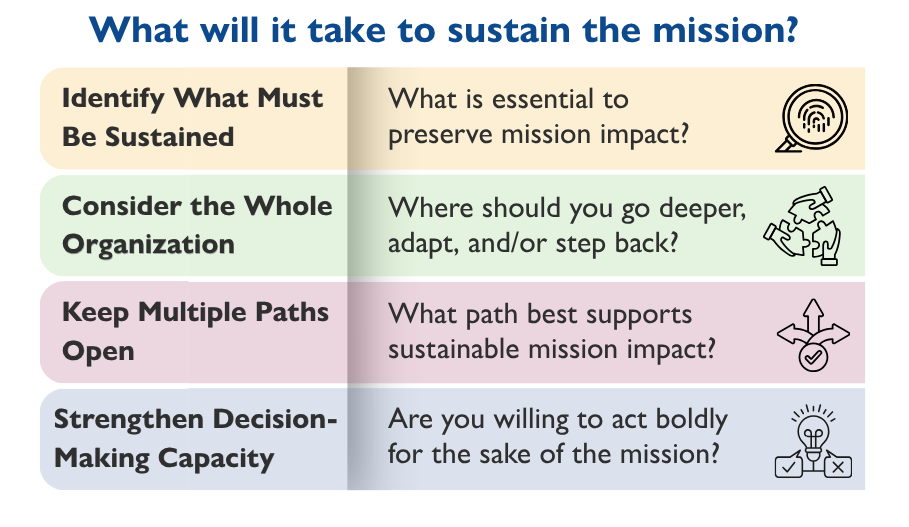
What will it take to sustain the mission?
A nonprofit is a vehicle for advancing its mission, not an end in itself. Mission sustainability planning helps leaders step back from the immediate pressure of the moment and consider what impact must endure, what may need to change, and which strategic path offers the strongest way forward.
Identify What Must Be Sustained
Planning for mission sustainability begins with clarity about purpose and impact. What does your organization contribute that is especially important to the people or communities you serve? Where are you distinctive? Which programs, relationships, capabilities, or roles are essential to the impact you want to preserve? And what can you realistically sustain with your current resources without burning out your staff? This is where honest assessment matters.
These questions create a firmer basis for decision-making than starting with the existing organizational chart or asking how every current activity can be maintained. They help leaders distinguish between what is familiar and what is truly mission-critical.
Consider the Whole Organization
Mission sustainability requires more than program strategy. It depends on whether the organization has the business model, leadership, staffing, systems, financial resources, and operating capacity to carry that strategy forward.
That means examining the connections among impact, money, and organizational capacity. Which programs contribute most meaningfully to the mission? What do they actually cost to deliver well? Which revenue streams are reliable, flexible, or vulnerable? Where is the organization stretched too thin? What capabilities will be needed for the future, and what work may need to stop?
These can be uncomfortable questions, particularly in organizations accustomed to responding to every need and pursuing every promising opportunity. Yet strategy requires choices. Growth is not automatically a sign of health, and maintaining every program is not always the best way to preserve impact.
A useful planning process gives leaders a consistent way to weigh opportunities and tradeoffs. Mission impact, equity, distinctiveness, community need, organizational capacity, and financial contribution can all inform decisions about where to deepen investment, where to adapt, and where to step back.
Keep Multiple Paths Open
Mission sustainability planning should not begin with a predetermined solution. Depending on the organization and its circumstances, the right path might include:
- Sharpening programmatic focus or discontinuing work that can no longer be sustained
- Redesigning services or changing how they are delivered
- Diversifying revenue or developing a more viable business model
- Investing in leadership, infrastructure, or other critical capabilities
- Restructuring roles and operations to align resources with priorities
- Sharing services or coordinating programs with another organization
- Pursuing an alliance, asset transfer, affiliation, or merger
Strategic partnerships belong on this list, but they are not the starting point. Start with the impact the organization seeks to sustain, then consider whether working with others would extend reach, preserve valued programs, reduce duplication, strengthen capacity, or create something that no organization could build alone. Rather than approaching collaboration only as a response to distress, organizations can consider it proactively as one of several tools for strengthening mission impact and positioning themselves for the future.
Strengthen Decision-Making Capacity
The most useful plan is not one that attempts to settle every future question. It is one that helps board and staff make better decisions as new opportunities, pressures, and information emerge. Some choices may involve loss: ending a program, redesigning jobs, narrowing the organization’s focus, or relinquishing a degree of autonomy. How leaders communicate and implement those decisions is part of sustainability too. Protecting the mission cannot be separated from supporting people, living organizational values, and maintaining the trust needed to move forward.
The current environment is pushing many nonprofits to reconsider what is possible, and what is sustainable. This is difficult work, but it can also open the door to greater clarity. By beginning with mission impact, testing the viability of the organization’s strategy and business model, and considering the full range of paths available, leaders can move beyond short-term survival and make thoughtful choices about what the future should hold.
Comment section