
Beyond the Merger Question: Choosing the Right Partnership
What years of nonprofit partnerships have taught us about choosing, and sustaining, the right form of collaboration
For years, the question we heard most often from nonprofit leaders was: Should we merge? Today, the more common question is:
What form of collaboration will best advance our mission, and what will it take to make it work?
It’s a nuanced but important shift that speaks to a growing sophistication and understanding in the sector. A merger is a powerful tool, but it is only one point on a much broader continuum. Across our work with nonprofits pursuing mergers, asset transfers, shared services, administrative agreements, and other forms of sustained collaboration, we have seen organizations become more creative around partnerships, and, importantly, more clear-eyed about what success requires.
Funding volatility, leadership transitions, rising costs, workforce pressures, and increasing community needs are prompting organizations to rethink how they operate, and partnerships are increasingly being considered as possible solutions to sustainability pressures. As more organizations consider an array of collaborative options, it’s important to remember that the strongest partnerships are strategic choices about how mission, talent, infrastructure, relationships, and resources can be combined to create something stronger than either organization could build alone.
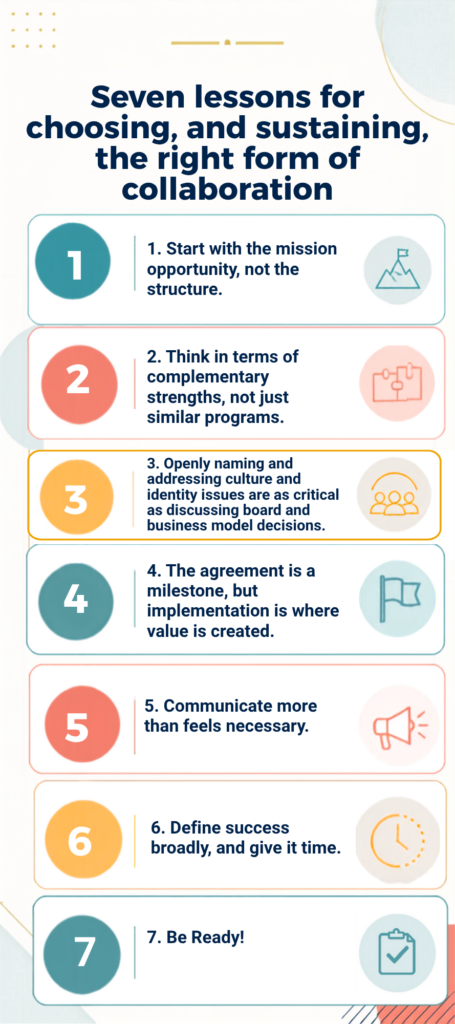
Looking across our client experiences and research, seven overarching lessons stand out.
1. Start with the mission opportunity, not the structure.
Too often, organizations begin by debating a particular transaction: merger or no merger? That framing can narrow the conversation before leaders have fully explored the problem they are trying to solve or the opportunity they hope to seize.
A more productive starting point is strategic: What impact are we trying to achieve? What capabilities, reach, or resilience will that require? What might become possible by working with others?
Those questions open the door to a wider range of options. As explained in Let’s Rethink Strategic Collaboration, an asset or program transfer can preserve and strengthen a valuable service without requiring two entire organizations to combine. Shared services may help organizations access stronger infrastructure while retaining their independence. An administrative agreement can provide a platform for deeper cooperation, and sometimes become a bridge to further integration. The right answer is the form that best serves the mission, not the one that sounds most ambitious.
This is also why organizations should explore partnerships before a crisis removes their choices. Collaboration from a position of strength allows for more creativity, better partner selection, and greater attention to long-term impact.
2. Think in terms of complementary strengths, not just similar programs.
Many nonprofit partnerships begin with programmatic alignment: two organizations serve similar populations, provide related services, or operate in adjacent geographies. But some of the most compelling opportunities come from a different kind of fit.
Imua Family Services offers one example. As described in Shared Strengths, Greater Impact, Imua recognized that its value to the community extended beyond its direct programs. Its management team, administrative systems, and operational infrastructure were themselves assets that could strengthen other mission-aligned organizations. Over time, Imua developed the capacity to pursue mergers, shared services, and other arrangements tailored to the needs of each partner.
This suggests a broader way of thinking about organizational strength. A nonprofit’s contribution to a partnership might be a trusted community presence, specialized expertise, a strong brand, fundraising reach, technology, financial systems, physical space, or leadership capacity. The strategic question is not simply, “Do we do the same thing?” but “What can we make possible together?”
3. Openly naming and addressing culture and identity issues are as critical to the process as discussing board and business model decisions.
Financial projections, legal structures, and governance arrangements are essential. But they rarely determine whether people ultimately experience a partnership as successful. Culture does.
Every organization carries its own habits, stories, loyalties, decision-making norms, and ideas about whose voice matters. Even when missions align on paper, differences in pace, power, communication, and leadership can create friction. Questions about identity are not distractions from the real work; they are the real work.
The unification of 27 Hostelling International USA entities illustrates both the opportunity and the challenge. In our interview with former HI USA CEO Russ Hedge, he described the ongoing work of preserving local uniqueness while building greater consistency and a common culture. The structural vote was consequential, but it did not complete the transformation.
Successful partners name cultural differences early, involve staff and board members in understanding them, and make explicit choices about what will be preserved, changed, or newly created. The goal is not for one culture to absorb the other. It is to build a shared way of working that honors what each organization brings while supporting the strategy ahead.
This requires partners to approach the process as an opportunity to build together, not just to negotiate terms. Negotiation can easily become an exercise in protecting what each organization already has: board seats, leadership roles, programs, names, or resources. Building together shifts the focus to a different set of questions: What does the new organization or partnership need to succeed? What should be preserved, what should change, and what can we create that neither organization could achieve alone? This does not eliminate difficult decisions or necessary negotiation. But it changes the posture from defending individual positions to designing a shared future.
4. The agreement is a milestone, but implementation is where value is created.
There is a natural tendency to treat board approval, contract signing, or legal closing as the finish line. In practice, that is when a different, and often more demanding, phase begins.
Systems must be aligned. Roles and reporting relationships must become clear. Staff need to understand what is changing and what is not. Funders, partners, clients, and community members need repeated communication. Leaders must keep the ongoing work moving while also building a new organization, operating model, or program home.
Our follow-up with the Council on Foundations about the transfer of CF Insights from Candid reinforced this point. As detailed in Lessons Learned from a Nonprofit Asset Transfer, the transition met its launch milestones, yet users still needed help finding the platform, logging in, and understanding whom to contact. The long tail was real. So were the eventual benefits: participation recovered and grew, and the program reached financial break-even sooner than projected.
The lesson is simple: do not underbudget the integration. Implementation requires dedicated leadership, project management, specialized advice, and time for stabilization. A strong partnership plan should extend well beyond closing and define how leaders will track operational progress, staff experience, stakeholder confidence, and mission impact.
5. Communicate more than feels necessary.
Across partnership models and organizations, this may be the most consistent lesson of all.
Communication begins well before a partnership is formalized. In our conversation with Yolanda Coentro, President and CEO of the Institute for Nonprofit Practice, she emphasized the importance of making collaboration part of an organization’s regular conversations, not waiting until external pressures force the issue. Inviting staff to reflect on the organization’s strengths, challenges, and adaptability can help build the shared understanding needed to consider partnership opportunities with purpose.
That need for dialogue only grows as a partnership moves from possibility to decision and implementation. Leaders may believe that once they have explained the rationale clearly, stakeholders will understand and move forward. But people absorb change at different speeds and through different channels. They also interpret new information through their own concerns: What does this mean for my job? Our clients? Our local identity? The programs I care about? The commitments we have made?
One announcement will not answer those questions. Communication must be ongoing, tailored, and two-way. It should provide consistent messages while creating genuine opportunities for people to ask questions, surface concerns, and influence implementation. And it should intensify, not taper off, after the formal decision, when uncertainty becomes concrete.
Repetition is not evidence that communication failed. In times of change, repetition is how clarity and trust are built.
6. Define success broadly, and give it time.
In our survey of past strategic-partnership clients, 92% of respondents who implemented an alliance described it as successful. They reported gains in program scope and quality, financial health, board culture, visibility, and interest from funders and collaborators. As importantly, organizations that explored a partnership but did not ultimately proceed still found value in the process.
That finding challenges two common assumptions. First, success is not limited to cost savings. It can include expanded reach, stronger programs, improved infrastructure, healthier governance, better talent deployment, greater strategic focus, or a more resilient ecosystem. Second, a decision not to combine organizations is not a failed process. A disciplined exploration can clarify strategy, surface risk, strengthen relationships, and help leaders make a well-grounded choice.
Partnership outcomes also unfold over time. Short-term disruption — a dip in participation, staff uncertainty, operational friction — does not necessarily predict the long-term result. Leaders and funders should establish realistic milestones and resist judging the partnership before the new model has had time to take hold.
7. Be ready!
Perhaps the most important trend we see is a shift from treating collaboration as an exceptional event to building it as an organizational capability.
Partnership-ready nonprofits do not wait until a specific merger opportunity arises. They cultivate relationships, understand their own strategic strengths and vulnerabilities, invest in adaptable systems, and develop boards and staff who can approach opportunities with curiosity rather than defensiveness. They know which aspects of identity are essential, and which structures are simply means to an end. They are prepared to assess opportunities quickly without rushing the trust-building and diligence that sound decisions require.
Funders have an important role to play as well. Exploration, diligence, negotiation, and integration all require capacity. Flexible funding, patient timelines, and access to experienced advisors can help organizations pursue the right partnership for the right reason, and follow through on the difficult work after the announcement.
The question for leaders now
In this volatile environment, it is understandable that collaboration conversations often begin with pressure: What can we no longer sustain on our own? But they should not end there. The more generative question is: What could we accomplish together that we cannot accomplish separately?
Answering that question may lead to a merger; or it may lead to an asset transfer, shared services, a joint venture, an administrative partnership, or a lighter alliance. Whatever the form, the overarching lessons remain remarkably consistent: begin with strategy, look for complementary strengths, attend to culture and power, invest in implementation, communicate relentlessly, and allow time for value to emerge.
The structure matters. But it is the quality of the partnership, including the shared decisions made before, during, and long after the agreement, that ultimately determines whether greater integration leads to greater impact.
Comment section