Shared Strengths, Greater Impact: Imua’s Partnership Approach
Nonprofit partnerships are often pursued as a way to expand programs or increase scale within a specific service area. Organizations identify their programmatic strengths and look to join forces with similar organizations to broaden their reach with a specific population or service type.
But partnerships can also take a different form, one that focuses less on expanding programs and more on sharing organizational strength. Some nonprofits are discovering that their greatest contribution to their community may lie not only in the services they provide directly, but also in the operational capacity, leadership, and infrastructure they can offer to other mission aligned organizations.
Imua, based in Maui in Hawai‘i and serving Molokai and Lana‘i, offers a compelling example of this approach.
While Imua has a strong reputation as a provider of quality care and community support so that children of all abilities can live to their full potential, the organization recognized another core competency in the strength of its management team and administrative infrastructure.
As Imua CEO Dean Wong explains:
“At Imua we built a strong core business team to support our mission, programs, and services, but realized we could have an even greater impact by being open to partnerships with other nonprofits that aligned with our values. These partnerships could leverage our systems and management team while simultaneously saving them tremendous money and resources.”
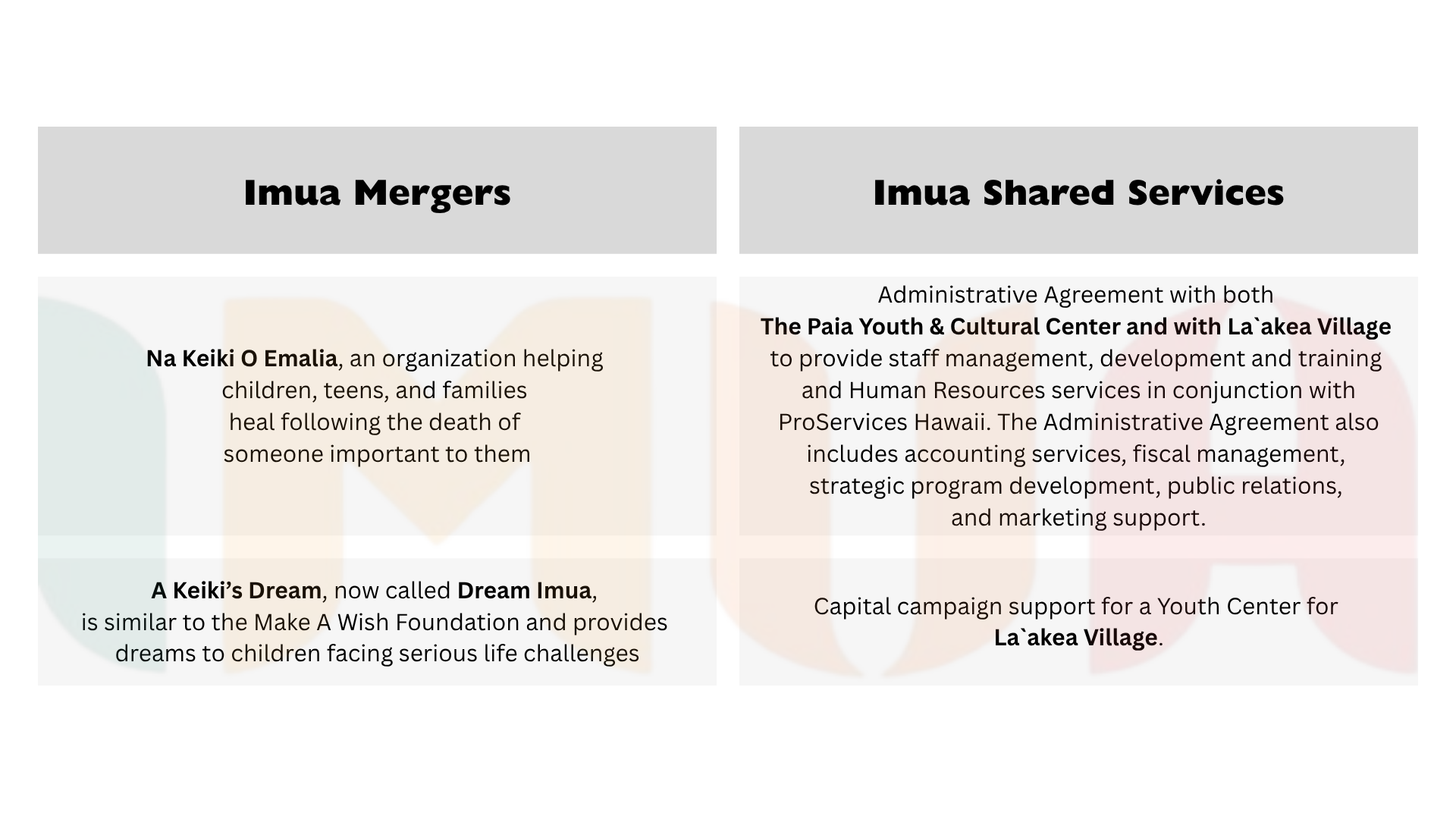
Over the last ten years, Imua has completed two mergers, provided shared services through an Administrative Agreement with another nonprofit, and is currently supporting an additional partner through shared services that include capital campaign support. Imua has become a power user of partnership strategies and has been intentional about building the internal capacity needed to grow in this way.
Board
Imua’s board is open to expanding its impact in a variety of ways. It is willing to take thoughtful risks and explore different types of partnership opportunities. The board takes a broad view of the nonprofit ecosystem across Maui and does not define Imua’s mission narrowly. Improving the overall conditions for children and young adults across the island ultimately strengthens Imua’s core purpose around helping children of all abilities reach their full potential.
Systems
Imua has invested in administrative systems that can flex to support other organizations. Rather than building systems solely for its own operations, the organization has designed its infrastructure with collaboration in mind. Internal systems such as accounting, CRM, and marketing functions are intentionally structured so they can be adapted as new partner organizations come on board.
Staff
Most importantly, the Imua team approaches partnerships with openness and curiosity. Staff have developed experience managing a range of partnership models, from deep integration through mergers to lighter shared services arrangements. They are able to evaluate opportunities quickly and remain nimble in establishing the processes and procedures needed to bring value as a new organization joins the family. Rather than being defensive about change, the team embraces the opportunity to be creative and better serve the community.
Imua will soon celebrate its 100th anniversary, yet it remains uniquely relevant in 2026. Its vision is that every child and youth will have what they need to thrive by 2030, and the organization is reimagining how to achieve that vision through a partnership strategy.
Today, Imua continues to provide direct services, including early intervention programs for children. At the same time, its impact is expanding through partnerships that support grief counseling, youth camps, a youth center, and training for young people focused on suicide prevention.
Imua is, in many ways, an old dog learning new tricks. It is building on a long history of service while redefining how it supports its community. By extending its strengths in management, leadership, and administrative infrastructure, Imua has created opportunities for other nonprofits to join the Imua family and strengthen their work while collectively expanding impact for children and youth across Maui.
At a time when many nonprofits struggle to envision how partnerships can work in practice, Imua offers a compelling example of what sustained collaboration can look like. Through mergers, shared services, and other partnership models, the organization is demonstrating how nonprofits can extend their reach and strengthen the broader ecosystem serving their communities. In doing so, Imua has forged a new path as an expert in sustained collaboration that works for all.
Comment section