
The Strengths & Limitations of Consulting RFPs
Every nonprofit eventually reaches a moment when it needs outside expertise. Whether the work involves strategic planning, governance, fundraising, technology, human resources, or organizational change, selecting the right partner is rarely just an operational decision. It is often a decision that shapes what happens next for the organization, the people it serves, and the impact it hopes to achieve. Each of these moments is more than selecting a professional service provider. It is a decision that will shape what happens next for your team, your organization, and your mission.
And in many cases, the stakes of these decisions are substantial:
- The outcome may be difficult to reverse.
- It may affect governance, authority, or resources.
- It may be a rare opportunity or set a direction that unfolds over months or years.
So, choosing a consulting partner is not just a procurement step. It is often one of the most consequential decisions in the work itself. And the real test of that decision comes later: when it needs to be carried out by your team, supported by stakeholders, and hold as conditions change.
A widely used tool for choosing service providers is a Request for Proposals (RFP). But like any tool, RFPs work better in some situations than others.
RFP Strengths and Limitations
An RFP can be a terrific tool when:
- The desired scope of work is clearly defined and repeatable
- The organization already knows what it wants done and how
- The goal is to compare similar approaches across vendors
In these situations, RFPs support:
- Consistency across proposals
- Transparent decision-making
- A sense of fairness in the selection process
But not all decisions look like this.
Many of the most important decisions nonprofit leaders make — especially those involving strategy, organizational change, partnerships, governance, or culture — are:
- Less predictable
- More dependent on judgment
- More sensitive to alignment, trust, and working style
In these cases, highly prescriptive RFPs can unintentionally:
- Lock in too many assumptions — and lead to the wrong solution
- Emphasize writing quality or low price over real capability and value
- Compare apples to oranges, making fit harder to assess
- Lead to selecting the strongest proposal rather than the right partner
The question is not whether RFPs are right or wrong. It’s whether the process you choose supports a high‑quality decision: one your organization can confidently act on without second‑guessing or reversing.
Different Tools for Different Decisions
Rather than defaulting to an RFP, it can be helpful to step back and ask:
What kind of decision are we actually making?
Then, consider that different decisions require different approaches. Choosing the right one increases your chances of making a decision you can stand behind.
Professional Service Provider Selection Approaches
| Approach | Best when… | This helps you answer… | Why it helps | Risk | Example |
| Traditional RFP Detailed scope defined in advance |
You know exactly what you need | “Who can deliver this work as defined?” | Easy to compare options side by side | You may invest in the wrong solution because the problem was defined too narrowly or incorrectly | Technology system implementation |
| Outcome‑ Focused RFP Desired results defined; approach left open |
You know what success looks like, and seek guidance on how to get there | “Who can help us achieve these results?” | Encourages new ideas and approaches | Poor fit can create friction, rework, and weaker results | Strategic communications campaign |
| Request for Qualifications (RFQ) Partner chosen based on fit, judgment, and experience |
Fit, judgment, and working style matter most | “Who is the right partner for this work?” | Focuses on trust, experience, and alignment | Without clear criteria, the decision may feel subjective or be harder to defend | Strategic planning or governance work |
| Request for Information (RFI) Early input gathered before defining scope |
The problem is complex or evolving | “What problem are we solving and how should we approach it?” | Builds shared understanding before setting scope | It may slow progress and create frustration if your team is not ready for an iterative process | Exploring a merger, partnership, or major business model shift |
| Direct Selection Trusted partner chosen without a competitive search |
You need to move quickly or already trust a partner | “Who do we trust to help us move forward?” | Fast start; builds on an existing relationship | The work may drift or lose focus if decision authority and priorities are not clear; the previous partner may not be the best fit for the work | Interim leadership or urgent strategy support |
Where to Start
Choosing the right approach begins with a clear understanding of the decision you’re making.
In each case, you should ask:
- Do we clearly understand the problem we’re trying to solve?
- Do we know what success looks like in practice?
- Does this work depend heavily on trust and judgment?
- How important is speed versus comparison?
The answers to these questions will point you toward the approach that best supports the decision.
Principles to Guide the Choice
A few principles can help nonprofit leaders choose a process that leads to stronger decisions.
Clarity about the decision beats prescription about the process
When you visit a medical professional, you describe your symptoms and desired outcome — you don’t prescribe the treatment yourself. Clear outcomes and a shared understanding of the decision matter more than detailed instructions for how providers should do the work. For complex challenges, the best approach — and the right scope — often emerge after engaging the right partner, not before.
Fit is a form of rigor
The most qualified partner on paper is not always the best partner in practice. Values, judgment, and working style shape results — especially in complex work. Selecting for fit is part of good decision-making and often comes down to a few practical questions:
- Do their values and approach align with yours?
- How do they work with people — direct advising, structured facilitation, or iterative co-creation?
- Do they apply an established approach or define the problem with you as understanding develops?
- Do you need deep expertise in your context, or a broader perspective that brings ideas from across the field?
- Do you trust how they listen, challenge assumptions, and navigate difficult conversations?
- What experiences shape how they interpret your situation?
When stakes are high and the path is unclear, these differences are not small — they determine how the work unfolds and whether the decision will hold.
Budgets are design inputs
Think of a budget less as a constraint and more as a design parameter. Budget ranges help shape realistic proposals, improve comparability, and reduce misalignment of expectations.
Conversation reduces risk
How much can you really learn about a partnership through a written proposal alone? Giving potential providers a chance to ask questions and clarify context can lead to stronger proposals, better outcome definition, better assessment of fit, and better decisions.
Decision authority should be clear
Too many good processes stall because no one is certain who has the final say. Before selecting a partner, reduce confusion and improve decision quality by being clear about:
- Who decides
- How the decision is made
- What criteria matter most
Choosing the Right Tool for the Decision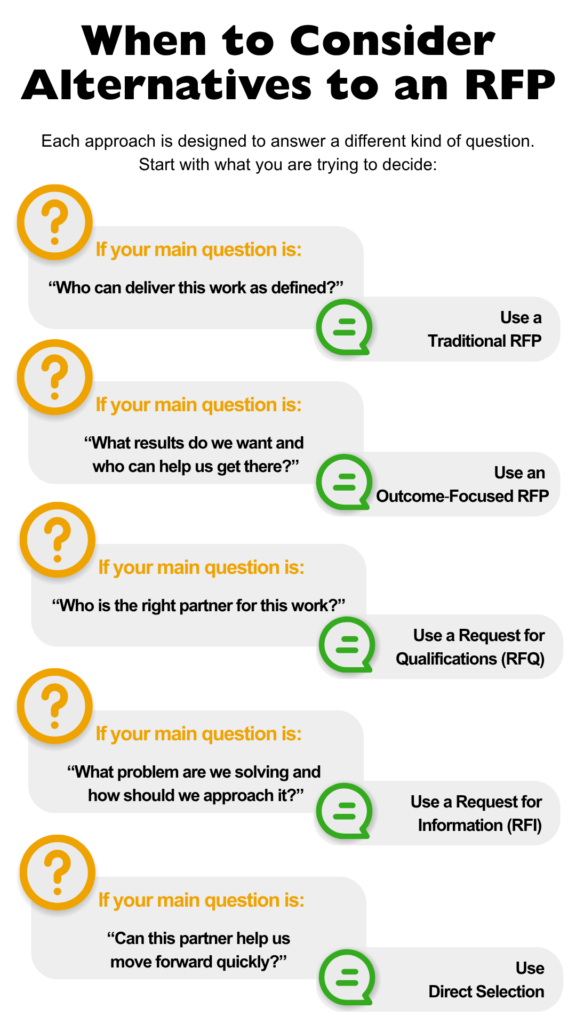
The goal is not to run a perfect process. It is to make a decision your organization can stand behind and carry forward. RFPs are one way to structure that decision. In the right context, they play an important role. But they are not always the best option.
When the work is complex, the path is uncertain, or the stakes are high, the quality of the decision depends on more than consistency or comparability. It depends on:
- How clearly the choice is framed
- Whether tradeoffs are understood
- Whether the right people are making the decision
- And whether the organization is prepared to follow through
Choosing a selection process that matches the decision doesn’t just improve how you choose partners. It increases the likelihood that the decision itself will hold:
- Organizationally — the people responsible for the work understand the decision, agree with it, and are able to carry it out in practice
- Politically — key stakeholders (board members, senior leaders, funders, partners) support the decision and do not revisit or undermine it after the fact
- Over time — the decision remains workable as conditions change, rather than needing to be reopened or reversed
Because the question isn’t simply:
Did we run a fair process?
It’s:
Did we choose a partner — and make a decision — we can stand behind and sustain?
Comment section