
Every Gathering Matters: Designing Meetings That Move Organizations Forward
“Gatherings crackle and flourish when real thought goes into them, when structure is baked into them, and when a host has the curiosity, willingness, and generosity of spirit to try.”
Does this describe your meetings? Or are you all too often leading / participating in a session in which people are busy checking email, or the agenda is vague and unhelpful, or you’re sitting through updates that go on forever? If you’re like me, the answer is too much of a mixed bag.
At a time when nonprofit leaders are navigating funding uncertainty, political polarization, staff burnout, and increasing demands with limited resources, every meeting matters. Yet too many of our work gatherings — whether it’s a weekly staff meeting, a monthly town hall, a board strategic planning retreat, or a session exploring potential collaborative relationships between different organizations — are routine, meandering, and ultimately less productive than they could be.
So, how can we do better?
After decades of facilitating strategic planning, board retreats, leadership meetings, and partnership negotiations, I’ve learned that improving meetings often begins by questioning our default assumptions and “go to” approaches. In that spirit, I revisited Priya Parker’s book, “The Art of Gathering: How We Meet and Why It Matters.”[1] This book and its online companion The New Rules of Gathering: A Guide to Planning with Purpose for Any Occasion, provide clear, accessible guidance relevant for anyone who plays a role in creating and leading meetings in the workplace.
Rather than defaulting to familiar routines, Priya Parker encourages us to design meetings with greater intention and understanding of some basic concepts.
First, she stresses the critical need to create a compelling purpose for the meeting. Underlying this thought process is consideration of whether a meeting is actually warranted, or if some other form of asynchronous communication will suffice. Assuming a meeting makes sense, thoughtfully developing its purpose will help ensure successful engagement with the participants.
More than simply describing what you will do, this purpose should reflect the reason for the convening (e.g., not just “an All-Hands meeting” or “reviewing our Q2 priorities” but “developing our approach to navigating the current political environment” or “deciding what work should sunset so we can protect and continue our most impactful programs”). In so doing, participants have greater clarity about why the meeting is happening and can begin to prepare to participate in a meaningful way.
Once you have established a compelling purpose, the next step is to thoughtfully consider who should participate — who can truly advance the purpose of the meeting and who might not. It is important to remember that the relationships brought into or developed during the meeting will affect participants’ experience and their willingness to share openly and directly. In Parker’s words, “Let the purpose be your bouncer.”
Next comes the meeting notice — these days, often an email or calendar invitation. Consider this a key touchpoint to set your meeting up for success. The invitation is not (only) logistics. It is an opportunity to describe the purpose and why the participants were asked to join. How can they contribute to advancing the purpose and what will be expected of them during the session? Sharing this information, perhaps with a few thought prompts, will help generate enthusiasm and preparation so that people will enter the meeting with excitement and ready to engage.
Your invitation can also be used to begin sharing some ground rules for the session. More than simply “meeting etiquette,” ground rules can signal and shape the ways participants engage with you as the facilitator and with the others in the room. These can also help establish the meeting as something other than their usual daily routine, noting that this “alternative space” has been specifically set up to achieve a particular purpose. And, while it can certainly be better practice to engage the group in establishing these guidelines, sharing something in the invitation can help prime them for that part of the conversation. One guideline I will often offer participants is to honor the time we will spend together in a way that fosters meaningful engagement. (“Think of this space as a gift! Honor it with energy, creativity, beauty, and a collaborative spirit.”)
When there are differences in titles, experience, and power in the same meeting, this type of guideline can signal that all participants are invited for a reason and that all have something to contribute. I’ve seen firsthand how this creates space for front-line or less experienced staff to raise difficult questions or challenge assumptions in conversation with executive staff or board members, which makes for a more engaged and thoughtful discussion and helps strengthen the relationships among the participants.
Once in the room, remember that the beginning and end of the meeting are key times to excite and frame the conversation and leave the participants with a feeling of su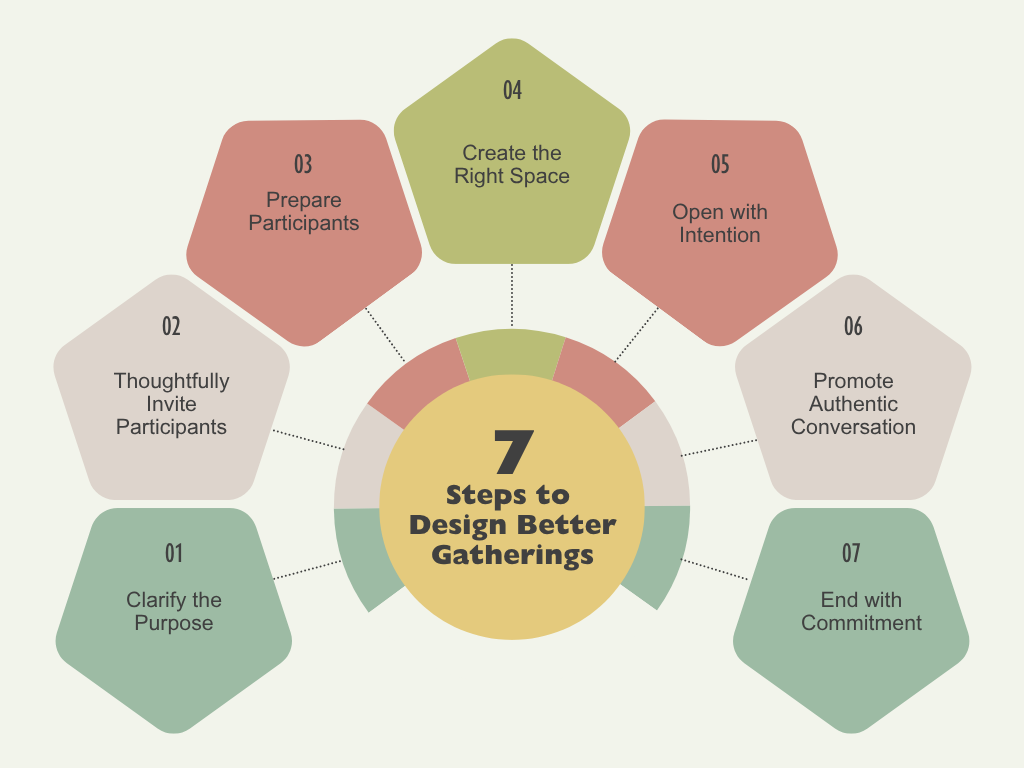 ccess as they leave. Don’t start or end a meeting with logistics; there’s almost no better way to have people glaze over than opening a meeting by sharing when lunch will arrive or the location of the restrooms!
And yes, do open with some type of “icebreaker!” But don’t spring it on people. In your pre-meeting communication, you can note that, for example, “we will start our session by asking people to share one hope they have for the meeting (or for their lives or community).” That allows the participants to prepare their comments in advance and creates an opportunity for them to begin to see each other as people rather than simply co-workers.
And then, create a meaningful and impactful ending. I will often ask folks to share an appreciation for someone or something that happened during the meeting, as well as something they commit to doing to follow up on any agreements reached. In this way, we retain our humanity as the meeting ends and carry its content and impact beyond the time we are together.
And, finally, Parker describes the importance of avoiding “being nice” and shutting down controversy or disagreement. The best decisions often emerge from thoughtful and respectful disagreements. As the facilitator, part of your job is to create a space in which difficult questions can be raised, assumptions challenged, and disagreements surfaced. Remember that the meeting is not about you and making you feel good! It’s about achieving the purpose in a way that serves the participants. Authentic conversation helps us get there. Organizations make better decisions when people feel safe enough to surface different perspectives before those decisions are made.
At La Piana Consulting, we’ve seen how thoughtfully designed gatherings can unlock better strategy, stronger governance, and more collaborative organizations. Parker’s book offers a useful framework for intentionally creating spaces that excite and engage participants, provide a sense of purpose, and help build relationships. And so, before sending your next calendar invitation, ask yourself: Why are we truly gathering? Who truly needs to be there? What should people be ready to do when they leave?
Every gathering is an opportunity — to build trust, strengthen team culture, make better decisions, and move meaningful work forward. The world is challenging enough these days. Our meetings should help us navigate it together.
[1] Parker, Priya, The Art of Gathering: How We Meet and Why It Matters.” Riverhead Press (New York: 2018)
Comment section