
Lessons from Serve Denton on Leading Through Financial Crisis
Nonprofit leaders are no strangers to uncertainty. But when financial pressures intensify and difficult decisions can no longer be postponed, many organizations face a defining moment. Some hesitate, hoping conditions will improve. Others make incremental cuts, trying to soften the impact.
And some make the hard decisions quickly and decisively.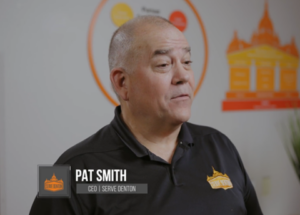
In a recent conversation with Pat Smith, CEO of Serve Denton, we explored what it looks like to lead through that moment. Serve Denton — a nonprofit shared space and services center in Denton, Texas — faced a sudden and severe financial shock when nearly half of its tenants lost funding and could no longer pay rent. Within a matter of weeks, the organization went from relative stability to a looming cash crisis.
What followed was not a slow decline, but a deliberate reset.
Facing the Reality
The turning point came quickly. With approximately 50 percent of tenants abruptly unable to pay rent, Serve Denton’s financial position deteriorated almost overnight.
There was no ambiguity about what needed to happen. The organization could not sustain itself without significant changes.
In moments like this, many nonprofits hesitate. They look for ways to soften the impact or delay difficult decisions, hoping conditions will improve. But as Pat described it, when the writing is on the wall, you cannot allow for a slow decline. You have to act.
“When the writing is on the wall, you don’t allow for a slow death.”
Making the Hard Call
One of the most difficult decisions was reducing staff. Serve Denton went from nine team members to five in a short period of time.
Rather than making incremental cuts over time, the organization chose to act decisively. The decision was clear, immediate, and communicated directly.
At the same time, how those decisions were carried out mattered just as much as the decisions themselves.
Staff were informed as soon as possible. They were given additional pay beyond their final working days. The CEO personally supported them in finding new roles, and every employee who was let go ultimately secured employment.
Pat describes his approach simply: “mission first, people always.”
The mission must come first. But that does not mean people are treated as expendable. It means leading with clarity and care at the same time.
“Mission first, people always.
You do what’s best for the organization, and you take care of people along the way.”
Holding the Line on What Matters
As the organization reset, not everything was cut.

Serve Denton made a deliberate decision to protect its core infrastructure. Finance, accounting, and development functions remained intact, even as other roles were reduced. These were not viewed as expendable costs, but as essential systems that allowed the organization to operate and recover.
That discipline extended beyond staffing. The organization conducted a deep review of expenses, identifying inefficiencies and reducing costs wherever possible. Even seemingly small changes, such as reducing janitorial supply costs from $3,200 to $600 per quarter, added up to meaningful savings over time. Serve Denton’s use of the Toyota Production System was invaluable in this effort of eliminating waste while adding value.
At the same time, strong financial management and consistent communication built trust with the organization’s lenders. Serve Denton was able to renegotiate key terms on its debt, preserving cash flow and maintaining stability.
Meanwhile, the organization took a hard look at its work. Expansion efforts and certain programs were paused. The focus shifted back to core operations, ensuring that limited resources were directed where they mattered most.
Stabilizing and Rebuilding
Cost reductions at Serve Denton created breathing room. But they were only part of the solution.
The organization moved quickly to generate new revenue. This included traditional fundraising, outreach to donors, and securing new grants. In a short period of time, the organization raised approximately $178,000 in unanticipated funds, including support from new funders.
Serve Denton also experimented with new approaches.
The Atomic Bingo Bash was a creative community event that drew more than 250 attendees, most of whom had no prior connection to the organization. The event generated a strong return and significantly expanded Serve Denton’s network of supporters.
The organization also began to diversify its revenue model. Leasing space to mission-aligned for-profit tenants, such as a counseling practice and a WIC-focused retailer, helped increase occupancy and stabilize income streams. These partnerships also supported Serve Denton’s broader vision of an integrated, “one‑stop shop” model that brings together healthcare and social services to better serve families in the community.
Positioning for the Future
As part of its reset, Serve Denton made a deliberate decision to refocus on its core model as a nonprofit shared space and services center.
Expansion efforts and certain consulting activities were paused — not abandoned, but intentionally set aside until the organization regained stability. At the same time, the team began building toward the future.
Serve Denton’s new strategic plan outlines a clear path forward, centered on long-term sustainability across financial, operational, property, and leadership dimensions. The organization is gradually restoring staff capacity, with plans to increase hours, provide raises, and thoughtfully rebuild its team over time.
The organization is also continuing to invest in areas of strength. Its training and consulting work, including its Operating with Excellence Seminar and the application of the Toyota Production System for nonprofits, has gained broad recognition, creating new opportunities for impact and revenue.
Even in the midst of rebuilding, the focus remains clear: strengthen the core, then grow from a position of stability.
What This Means for Nonprofit Leaders
Serve Denton’s experience offers a clear set of lessons for organizations facing similar challenges:
- Act quickly when financial realities become clear. Delaying decisions often makes recovery more difficult.
- Make hard decisions decisively rather than incrementally. Prolonged uncertainty can be more damaging than a single, clear shift.
- Put mission first while still taking care of people. The two are not mutually exclusive when handled with intention.
- Protect core infrastructure. Pause what is not essential. Strong financial, operational, and development systems are essential to stability. Clarity enables effective use of limited resources.
- Pair cost reductions with aggressive revenue generation. Stabilization requires both discipline and creativity.
- Use crisis as an opportunity to improve how the organization operates, not just reduce what it does.
At its core, this is a story about leadership.
Many nonprofits facing similar pressures hesitate. They delay decisions, soften the message, or hope that external conditions will change. In some cases, that hesitation leads to a gradual erosion of resources, credibility, and ultimately, viability.
Serve Denton took a different path. It faced the reality of its situation, made difficult decisions quickly, and aligned its actions around a clear priority.
The result is an organization that is not only surviving but positioned to move forward with strength.
Looking Ahead
At La Piana Consulting, we work with nonprofit leaders navigating complex decisions, including moments of financial strain, strategic reset, and organizational transformation.
If your organization is facing difficult choices or seeking a path forward, we invite you to learn more about our work and how we support leaders in aligning strategy, operations, and mission for long-term sustainability.
Comment section