
Grounded and Growing: Reflections on Support, Power Dynamics, and Professional Growth
As an Associate Consultant with La Piana, I manage projects and help connect the many moving parts that make up a larger effort. I am often stewarding the bits and pieces that form the whole. If I’m leading, it is often from the bottom up — a muscle I am still, happily and humbly, developing.
I say that as context, not complaint. I’m not sure how many people in support roles or mid-career read our blog, but this one is written with us in mind.
It has been a rough, unsettling stretch for the social sector. Organizations are navigating funding squeezes, capacity strains, AI reshaping how work gets done, and the exhaustion of trying to do good work in an environment that can feel actively hostile to it. There is a lot being asked of people right now, and it does not always feel like there is much room to ask for anything back.
Here is what I keep coming back to, though: I’m determined to build my capacity to grow and stay grounded while things feel shaky.
For me, that has meant practicing three small moves: acknowledging, staying curious, and taking space.
Acknowledge
Some days, there is a lot of absorbing.
An email goes unanswered, then another. A project thread moves forward without including the person responsible for holding the timeline together. A contribution is treated as “just logistics,” even though the logistics keep the train on the tracks. A meeting gets scheduled, a decision gets made, a next step gets assigned, and the people responsible for coordinating are left on the periphery.
Most of the time, I do not think it is a conscious effort to leave parts of the project team out in the cold. But hierarchy is sneaky. It enters through habits — like who gets copied, who gets asked, who gets thanked, who is trusted with context, and who is expected to simply make it all work.
I am trying to unlearn absorbing those moments.
So I am practicing plain, constructive naming. Just honest sentences that invite people back into a fuller understanding of the work:
“This thread would benefit from including the person coordinating the process.”
“I can facilitate that interview; here is the frame I plan to use.”
“The coordination is part of the strategy, not separate from it.”
Sometimes it’s awkward to try to bridge the gap. But acknowledging helps create a chance for shared ownership, clearer expectations, and a more inclusive way of moving the work across the finish line.
Acknowledging what is happening does not mean keeping a running list of grievances. It means noticing the patterns that shape our work and naming them in ways that make better participation possible.
Stay Curious
There is so much pressure to do and produce that, when support feels overlooked, there is real temptation to pull back. I am trying to get curious before I make assumptions about intent. This is where curiosity becomes more than a nice personal trait; it becomes a practice of accountability.
In a previous blog on transformative feedback, I reflected on how meaningful feedback has to acknowledge power dynamics and move in multiple directions. This feels like the lived version of that idea. Sometimes feedback is the gracious but uncomfortable sentence after a meeting. Sometimes it is saying, “I felt thrown under the bus there, and I want to understand what happened.” Sometimes it is asking, “What did we miss in our communication that created confusion?”
That kind of curiosity is not passivity. It is not pretending impact did not happen. It is a way of staying accountable to relationship and repair without making blame the main character.
Urgency compounds. Tone can get misconstrued over Teams. Emails can come across as colder than intended. A missed handoff can become a whole thing. In those moments, vulnerability can create enough oxygen for people to be imperfect and accountable together.
I am grateful to work in an environment where this kind of practice is possible. Not always easy. Possible. And that distinction matters.
Take Space
The third move is the one I am still learning in real time: to take space.
I am learning there is a difference between humility and invisibility.
Taking space, to me, does not mean elbowing people out or confusing volume with leadership. It looks quieter than that. It means offering a perspective. It means asking to be included in the planning conversation because the implementation details are not secondary, they are part of making the strategy work.
It also means trusting that my contribution is not valuable despite my role, but valuable in part because of it.
And this cannot be only an individual act of bravery. People with less positional power should be invited to take space, and the conditions should be created so they can do so meaningfully and successfully.
Those with positional power have a particular responsibility here. Culture is shaped by what leaders reward, tolerate, interrupt, and make possible. If organizations want new ideas, future leaders, and more resilient teams, they must create opportunities for people who are still developing to contribute visibly, take thoughtful risks, and be seen.
Taking space is good for the individual, yes. It stretches us. It builds confidence, judgment, and range. But it is also good for the work. Support and administrative professionals often sit close to the friction points, the handoffs, the small breakdowns, the places where intention and implementation do not quite line up. That vantage point is useful.
A Quick Framework
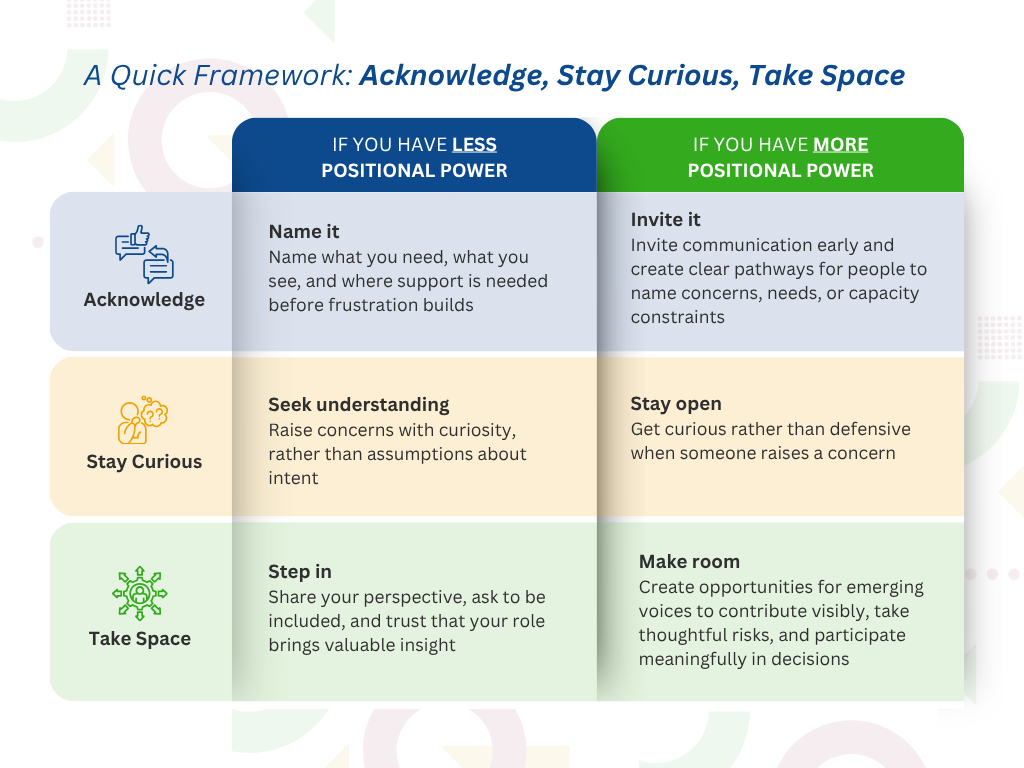
None of this is particularly easy. Power dynamics rarely are. Whether you hold more positional power or less, we all have a role to play in shaping how people experience the work and one another. The framework below offers a few practical ways to think about acknowledging what is happening, staying curious when tensions arise, and taking space in ways that support both individual growth and collective success. Wherever you sit in an organization, these practices can help turn everyday interactions into opportunities for connection, learning, and a more inclusive approach to getting the work done.
Wow. This is such a thoughtful and thought-provoking blog piece. I great read for anyone who is invested in the success of their team. D