
Lessons Learned from a Nonprofit Asset Transfer: Insights for a Smooth Transition
Reflecting on Conversations and Key Takeaways for Nonprofit Leaders
Nonprofit asset transfers are often discussed in terms of strategy, structure, and due diligence. But far less attention is paid to what happens after the transfer agreement is signed. What does implementation actually look like? What separates a transition that simply works from one that truly delivers value?
Recently, Partner Lara Jakubowski spoke with David Rosado, Senior Advisor for Community Philanthropy at the Council on Foundations, about the transfer of CF Insights from Candid to the Council, which La Piana supported in 2022–2023. CF Insights is a membership-based, data-driven platform designed specifically for community foundations to analyze their performance, sustainability, and growth compared to industry peers.
Prior to joining the Council, David led CF Insights at Candid and transitioned alongside the program during the transfer. Continuity was kept at the core of the transition process, with the Council maintaining the CF Insights brand and core offerings, and David continuing his role as the program’s main contact, allowing for a seamless experience for members. Reflecting on the transition, he shared insights into what it took to successfully integrate CF Insights into its new organizational home.
Below are seven key lessons that emerged for nonprofit leaders navigating similar transitions, emphasizing how thoughtful implementation can strengthen both the program and the field it serves.
1. Plan for the Work After the Transfer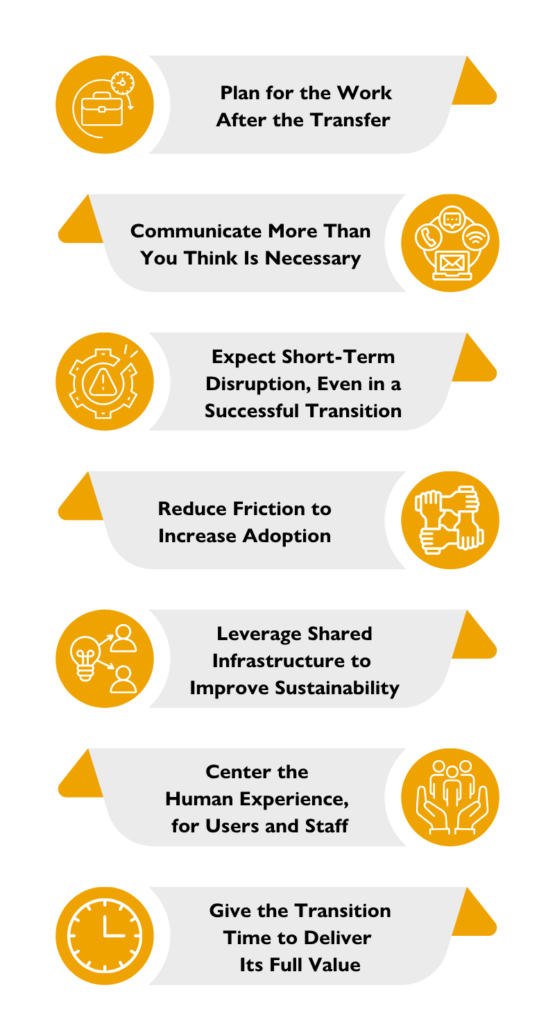
One of the biggest misconceptions about asset transfers is that the hard part ends at closing. In reality, implementation is where complexity often shows up.
Even in the transition of CF Insights from Candid to the Council on Foundations, which met its launch deadline and technical milestones, there were still lingering questions from users. Members needed clarity on where to find the program, how to log in, and who to contact for help. Some continued reaching out to Candid simply because habits take time to change.
Maintaining continuity helped ease that transition. The Council intentionally preserved the CF Insights brand, its core offerings, and many aspects of the member experience to reduce disruption for users already familiar with the platform. David’s transition alongside the program also created consistency for members, allowing them to continue working with a trusted contact throughout the change process.
The takeaway:
Expect a long tail of transition work. Build in time and capacity not just for launch, but for stabilization. Communication, troubleshooting, and user support will continue well beyond day one.
2. Communicate More Than You Think Is Necessary
If there is one theme that came through clearly, it is this: one announcement is never enough.
Throughout the transition, multiple touchpoints were used to guide users step by step. Even then, questions persisted. As David noted in our conversation, “it was less about a single clear message and more about providing ‘breadcrumbs’ that users could follow over time.”
The takeaway:
Repetition builds clarity. Plan a communication cadence that meets people where they are, not where you expect them to be.
3. Expect Short-Term Disruption, Even in a Successful Transition
At the time of transfer, CF Insight membership dropped as some organizations paused participation while they waited to see how things would unfold.
This kind of dip can feel alarming, but in this case, it was temporary. Over time, membership not only recovered but doubled, surpassing previous levels.
The takeaway:
Do not judge success too early. Transitions often create uncertainty in the short term, but that does not predict long-term outcomes.
4. Reduce Friction to Increase Adoption
One of the most impactful changes post-transfer was operational, which led to strategic change as well. Participation became easier. And by integrating CF Insights into a broader membership model at the Council on Foundations, organizations could simply check a box to opt in. What was once a standalone product became part of a bundled experience, while still maintaining the recognizable CF Insights identity and core value members had come to trust.The result was not only growth in participation but also increased perceived value for users and greater engagement with the Council on Foundations overall.
The takeaway:
Simplification drives engagement. Investment in streamlining access, reducing decision points, and integrating offerings pays off for a long-term strategy.
5. Leverage Shared Infrastructure to Improve Sustainability
At its core, this asset transfer was about better alignment — not just of mission, but of operations.
Within the Council on Foundations, shared infrastructure across membership, communications, and operations teams made it possible to distribute responsibilities more effectively and reduce duplication of effort. This allowed staff to focus more deeply on their areas of expertise, rather than managing every aspect of the program independently.
Just as importantly, the Council’s focus on serving community foundations created a natural strategic fit. CF Insights now sits closer to its core audience and can evolve alongside it.
The financial impact of the transition was significant. While initially projected to break even by year three, the program reached break-even in year one and generated a surplus in year two.
The takeaway:
The right organizational home matters. When programs are aligned with infrastructure, strategy, and audience, they are more likely to thrive.
6. Center the Human Experience, for Users and Staff
Behind every transition are people adapting to change.
For users, that meant clear communication, simple onboarding, and tangible value, including cost savings and a more seamless experience. For staff, it meant moving from siloed work to a more integrated environment, with clearer support systems and opportunities to focus on higher-value activities.
Strong operating principles — such as prioritizing relationships, transparency, and thoughtful onboarding — helped create a sense of trust and continuity throughout the process.
As Natalie Ross, Vice President, Membership, Development and Finance at the Council on Foundations, reflected:
“When we brought CF Insights to the Council on Foundations from Candid, we knew we were acquiring a platform that would strengthen our ability to support community foundations. But it was clear, constant stakeholder communication and intentional systems planning that made CF Insights even more successful, faster, than we expected.”
The takeaway:
Successful transitions are as much about people as they are about process. When leaders prioritize the human experience, they create the conditions for trust, adoption, and long-term stability.
7. Give the Transition Time to Deliver Its Full Value
Perhaps the most important lesson is that the benefits of an asset transfer often emerge over time.
What began as a strategic move to better serve community foundations evolved into something more. The transition led to expanded reach, improved efficiency, and the ability to reimagine future offerings and audiences.
But none of that happened overnight.
The takeaway:
Build for the long term. A well-executed transition creates the foundation for what comes next, not just continuity, but growth.
What This Means for Nonprofit Leaders
Too often, asset transfers are framed as complex, risky, or disruptive. But this example offers a different perspective. With thoughtful planning, strong communication, continuity in relationships and user experience, and the right organizational alignment, , as seen in this transition of CF Insights to the Council on Foundations, transfers can feel not only smooth, but transformative.
For nonprofit leaders considering similar paths, the question is not just whether an asset transfer can work, but how intentionally it is implemented.
Comment section